Plasma Aluminium Diecasting is a low pressure die casting (LPDC) manufacturer in Pune, India, producing high - integrity aluminium structural components for automotive, aerospace and industrial applications. The LPDC process delivers superior metallurgical consistency and is particularly suited to large components like wheel hubs, knuckles and suspension parts.
The automotive wheel and structural casting segment in India is growing rapidly, driven by the premiumisation of passenger vehicles and the transition to alloy wheels across mass - market segments. LPDC is the dominant process for these applications globally - and yet relatively few manufacturers in Pune's industrial belt offer genuine, controlled LPDC capability. This capability gap is precisely what Plasma Aluminium Diecasting was built to fill.
Low Pressure Die Casting Manufacturer in Pune – High-Integrity Aluminium Components
What is Low Pressure Die Casting?
Low Pressure Die Casting (LPDC) is the process of choice for aluminium components where
metallurgical integrity cannot be traded away. It is the process behind most automotive
alloy wheels, suspension knuckles and aerospace structural components—applications where
porosity, segregation, or inconsistency in mechanical properties are not acceptable failure
modes.
Plasma Aluminium Diecasting is a Low Pressure Die Casting manufacturer in Pune offering
controlled, process-disciplined LPDC production for automotive, aerospace and industrial
clients. Our facility in Pune serves the Chakan MIDC corridor, Moshi MIDC and clients across
India who need precision LPDC components with full in-house machining and post-casting
capability.
How Low Pressure Die Casting Works
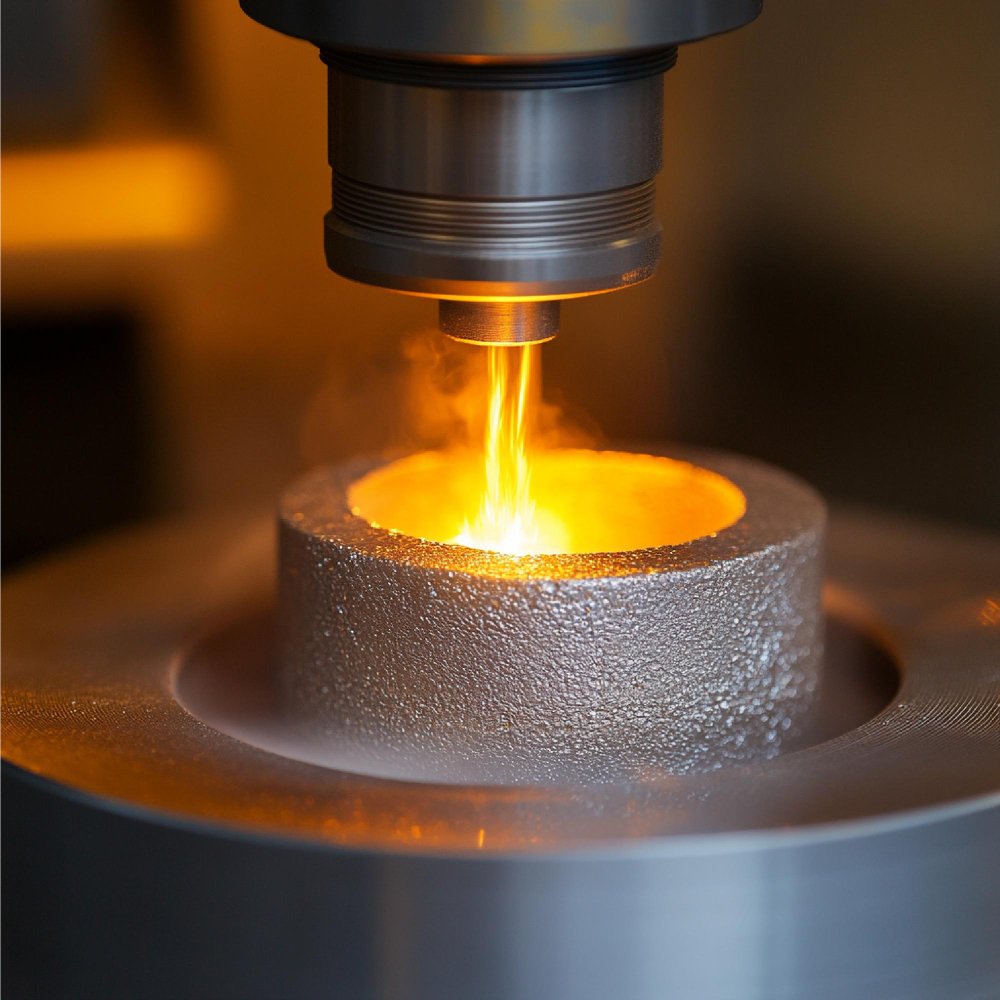
In the LPDC process, a sealed furnace holds the molten aluminium below the die. Controlled
low gas pressure—typically between 0.3 and 1.5 bar—pushes molten metal upward through a
riser tube into the die cavity from below. This filling method offers several critical
advantages over conventional casting approaches:
- Minimal turbulence: The
controlled, laminar upward flow eliminates the turbulence and air entrapment that
cause porosity in conventional methods.
- Directional solidification: As the
casting solidifies, fresh molten metal is continuously fed from the furnace below,
compensating for shrinkage and producing dense, sound castings.
- Consistent fill pressure:
Controlled pressure throughout filling ensures the die cavity is completely and
consistently filled without cold shuts or misruns.
- Superior mechanical properties:
The combination of laminar fill and directional solidification produces castings
with higher tensile strength, yield strength and elongation than most other casting
methods.
Applications of LPDC – Where Integrity Is Non-Negotiable
Automotive
Structural Components
- Alloy wheel hubs and full alloy wheels
- Front and rear suspension knuckles and upright
castings
- Subframe structural components
- Steering column housings and crossmember brackets
Aerospace
and Defence
- Structural housings and enclosures
- Complex castings requiring X-ray inspection
- Aerospace-grade aluminium alloys
- Tight chemistry and mechanical property requirements
Industrial
and Engineering
- Large pump casings and fluid systems
- Structural machine frames and base castings
- Oil, gas and process industry components
- High-specification demanding applications
Why LPDC Produces Superior Castings
The metallurgical advantages of LPDC over both HPDC and conventional gravity pouring are
well established. Here is a direct comparison:
-
vs HPDC: LPDC produces
significantly lower porosity levels because fill is laminar, not turbulent. LPDC
castings are more suitable for pressure testing, heat treatment and applications
where fatigue life is critical.
-
vs Sand Casting: LPDC uses
permanent steel moulds, producing consistent geometry, better surface finish and
tighter dimensional tolerances than sand casting, at comparable or better mechanical
property levels.
-
vs GDC: LPDC's continuous
metal feed from below provides better shrinkage compensation and more consistent
directional solidification than gravity pour methods.
Plasma's LPDC Capability and Process Controls
Our LPDC operation at Plasma is built around process control and reproducibility:
- Die design and thermal management:
LPDC tooling requires careful thermal analysis to ensure solidification occurs
directionally. Our in-house tooling team designs cooling and heating circuits into
the die to achieve this consistently.
- Pressure profile programming: Each
LPDC cycle runs on a programmed pressure profile—filling rate, holding pressure and
pressure release—tuned to the specific component geometry and alloy.
- Metal quality management:
Degassing and flux treatment before pouring are critical in LPDC to prevent hydrogen
porosity. We control melt quality carefully before each production run.
- First-article and in-process
inspection: Dimensional, visual and where required X-ray inspection of
samples throughout production.
- Post-casting operations: In-house
CNC machining and T6 heat treatment coordination for final mechanical property
development.
LPDC Alloys at Plasma
LPDC is particularly well suited to alloys that benefit from controlled solidification:
- A356 / LM25 (Al-Si7Mg): The global
standard for automotive wheel and structural LPDC applications. Responds excellently
to T6 heat treatment, achieving tensile strengths of 290 MPa and above with
elongation values that satisfy crash-performance requirements.
- A357 (Al-Si7Mg0.6): A
higher-specification variant of A356 with tighter chemistry control, used in
aerospace structural applications.
- LM6 (Al-Si12): Excellent corrosion
resistance and good castability, used where environmental resistance is prioritised
over maximum strength.
Quality Assurance in LPDC
LPDC components at Plasma are subject to a comprehensive quality programme designed for
structural and safety-critical applications:
- Melt chemistry verification before each
cast
- Degassing and flux treatment records
maintained for traceability
- Pressure profile and cycle time data
logged for every component
- First-article dimensional inspection with
full report
- Visual and X-ray inspection for internal
integrity where specified
- Mechanical property verification via coupon
testing or destructive sampling where required
LPDC Manufacturing in Pune – Serving Chakan, Moshi & India
Plasma's Pune location places our LPDC capability within direct reach of automotive
manufacturers in Chakan MIDC and Moshi MIDC—exactly where the demand for structural
aluminium castings is concentrated. Whether you are a wheel manufacturer, suspension
component supplier, or structural parts fabricator, our team can discuss your LPDC
requirements and provide a detailed technical quotation.
Contact Plasma Aluminium
Diecasting today for a consultation on your Low Pressure Die Casting
requirement.